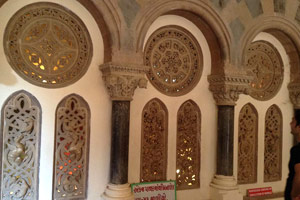
Aina Mahal is an 18th-century palace in Bhuj, Gujarat, India. It is located next to the Prag Mahal. It was built by Rao Lakhpatji in 1761.The chief architect and designer of Aina Mahal was Ram Singh Malam, who was assisted by local builder community (Mistris of Kutch) in construction. It was constructed with marble walls adorned with gold lace and glass. The walls of the palace are of white marble covered with mirrors separated by gilded ornaments with shades of Venetian glass.
The pleasure room of Rao Lakhpatji in Aina Mahal.The palace was damaged in the 2001 Gujarat earthquake. However, a portion of the palace which was not so badly damaged has been restored and it houses the museum, displaying the bed room, music room, court room and other old pieces of arts, paintings, arms, palanquin etc.
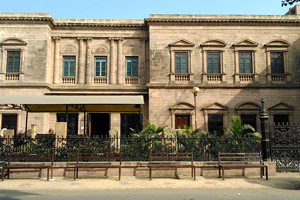
Kutch Museum in Bhuj is the oldest museum of Gujarat. It is located on Kutch Museum Road, Ghanshyam Nagar, opposite Hamirsar Lake at Bhuj, Kutch.Kutch museum was initially formed as a part of the School of Arts established by Maharao Sir Khengarji III, which was founded on 1 July 1877. The museum was earlier known as Fergusson Museum.
At the time of Maharao Khengarji III’s marriage on 19 February 1884 many new items were received and for exhibition of which, a need for new building was necessitated. As such, on 14 November 1884, the foundation stone for the present museum building was laid by the Governor of Bombay, Sir James Fergusson and named Fergusson Museum after him by Maharao of Cutch. The building consisting of two floors cost Rs. 32000 at that time. The museum, constructed in the Italian Gothic style, is located in the picturesque surroundings on the bank of Hamirsar Lake just opposite to the Nazar Bagh Garden. It was designed by the state engineer – Mc Lelland and built by local builders known as Mistris of Kutch under supervision of state Gaidher – Jairam Ruda Gajdhar. The museum remained the preserve of the Maharao of Cutch, till 1948, who showed it only to his personal guests. In those days museum was opened to the public only on important religious occasions.